Das Kabinenbild ist lediglich ein Beispiel.
Abweichungen sind möglich.
 Das Kabinenbild ist lediglich ein Beispiel.
Abweichungen sind möglich.
 Das Kabinenbild ist lediglich ein Beispiel.
Abweichungen sind möglich.
 Das Kabinenbild ist lediglich ein Beispiel.
Abweichungen sind möglich.
 Das Kabinenbild ist lediglich ein Beispiel.
Abweichungen sind möglich.
 Das Kabinenbild ist lediglich ein Beispiel.
Abweichungen sind möglich.
 Das Kabinenbild ist lediglich ein Beispiel.
Abweichungen sind möglich.
 Das Kabinenbild ist lediglich ein Beispiel.
Abweichungen sind möglich.
 Das Kabinenbild ist lediglich ein Beispiel.
Abweichungen sind möglich.
 Das Kabinenbild ist lediglich ein Beispiel.
Abweichungen sind möglich.
 Das Kabinenbild ist lediglich ein Beispiel.
Abweichungen sind möglich.
 Das Kabinenbild ist lediglich ein Beispiel.
Abweichungen sind möglich.
 Das Kabinenbild ist lediglich ein Beispiel.
Abweichungen sind möglich.
 Das Kabinenbild ist lediglich ein Beispiel.
Abweichungen sind möglich.
 Das Kabinenbild ist lediglich ein Beispiel.
Abweichungen sind möglich.
 Das Kabinenbild ist lediglich ein Beispiel.
Abweichungen sind möglich.
 Das Kabinenbild ist lediglich ein Beispiel.
Abweichungen sind möglich.
Erfahren Sie es zuerst!
Abonnieren Sie unseren Newsletter:
Wählen Sie jetzt noch eine passende Kabine und entdecken Sie polare Welten! Alle Informationen zu dieser Reise mit dem Reisecode RACAN03R-280917 können Sie ausdrucken oder speichern.
Reisetermin
17.09. - 05.10.2028 (19 Tage)Reederei
HX ExpeditionsSchiff
MS Roald Amundsen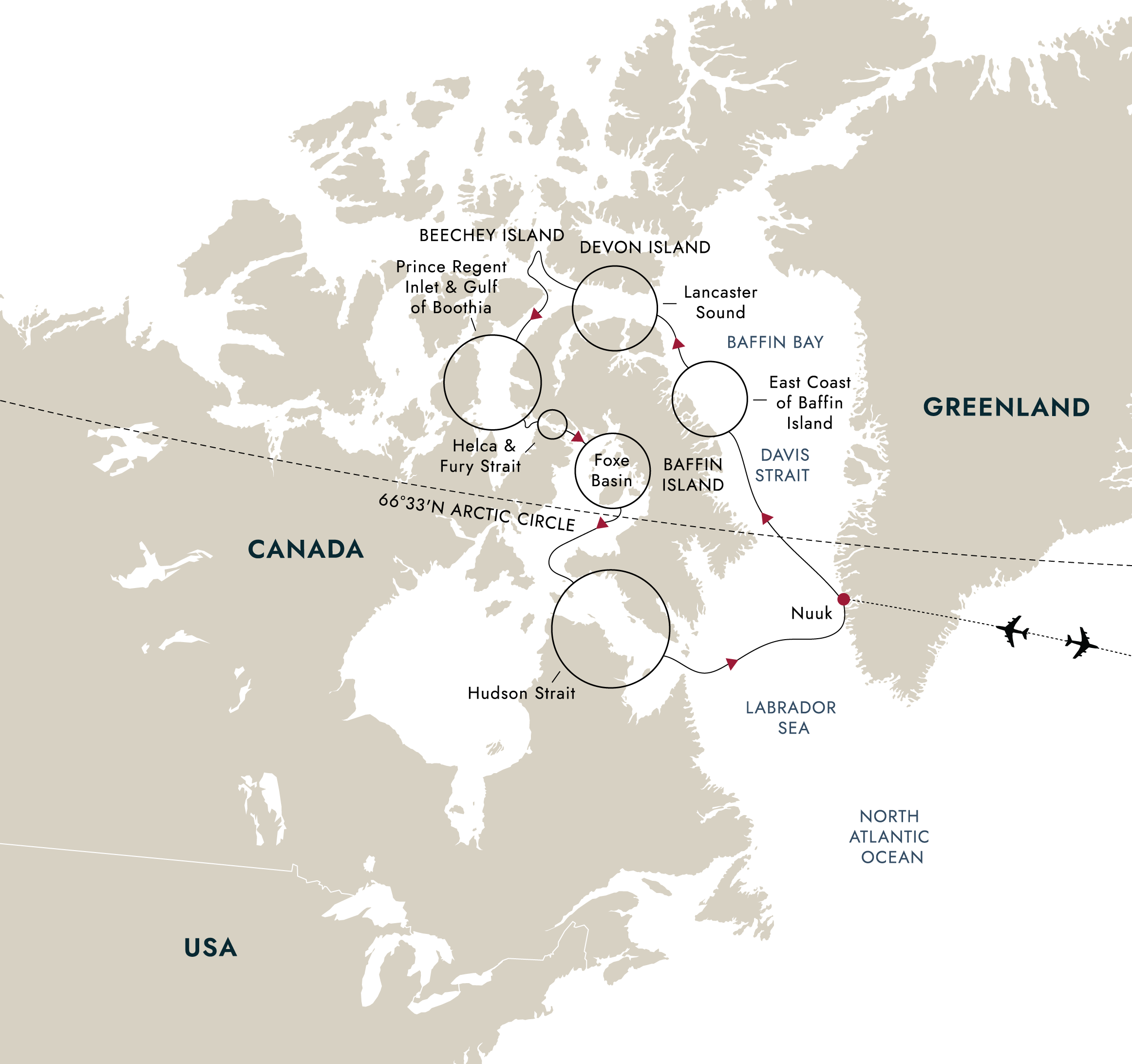
Reiseverlauf abhängig von Wetter- und Eislage. Beschriebene Naturerlebnisse/Tiersichtungen sind mögliche Ereignisse auf den Expeditionen und nicht garantiert.
Gateway to the Greenlandic Arctic
Flight from Reykjavik to Nuuk.
Greenland’s compact capital is set along a deep fjord system framed by rugged mountains. Despite its small scale, the city is a vibrant centre of modern Greenlandic life.
If time allows, you can explore the harbour, museums, and historic districts before embarkation. Nuuk is also where you start to feel the essence of the Arctic: ice, sea, and the mountainous peaks of Quassussuaq and Ukkusissat.
Once on board, meet the Expedition Team, settle into your cabin, and we’ll begin the voyage north and west towards Baffin Island.
A day at sea
As Nuuk fades into the distance, we begin our first sea passage into the waters of Baffin Bay. Look out for seabirds following the ship and watch as the landscape begins to shift.
This is a time of orientation: both practical and environmental. With onboard lectures, you’ll get an introduction to ice navigation, wildlife patterns, and Arctic history, while the landscape slowly transforms from coastal Greenland into open polar seascape.
Ice-carved coasts and living Arctic communities
The eastern edge of Baffin Island reveals some of the most dramatic scenery in the Arctic: steep mountains, deep fjords, and glaciers descending directly into the sea. Sea ice often lingers here, shaping access and movement throughout the region.
In settlements such as Qikiqtarjuaq, life is in close connection with land and sea, where hunting, fishing, and travel remain guided by environmental conditions. Zodiac cruising and shore landings, where possible, offer encounters with this immense coastal landscape and its wildlife-rich waters.
Science at sea
Time at sea allows the scale of the region to settle in. Baffin Island’s vast coastline stretches behind while new regions approach ahead. Sea conditions can shift rapidly, from open water to scattered ice, requiring constant observation and adaptation.
Onboard life continues with lectures and sessions that bring the Arctic environment into focus: how ice forms, how ecosystems function, and how navigation in these waters is shaped by nature rather than fixed routes.
Gateway to the Northwest Passage
Lancaster Sound is one of the most important waterways in the Arctic. It’s a historic entry point into the Northwest Passage. We’ll pass towering cliffs and deep channels along the coast of Devon Island, which is the largest uninhabited island on Earth. Conditions permitting, we may visit Beechey Island, an important historical site associated with early Arctic exploration, including Sir John Franklin’s 1845 expedition.
Into the shifting ice
Sailing deeper into the Canadian High Arctic, the environment becomes more enclosed and remote. Prince Regent Inlet and the Gulf of Boothia are defined by long, quiet waterways, low-lying tundra, and the first patches of sea ice forming in the late Arctic autumn. With a little luck and patience, wildlife such as ringed or bearded seals may make an appearance along the ice edges.
Wide seas and Inuit homelands
Foxe Basin opens into a vast, shallow sea bordered by low tundra and distant, broken coastline. It feels open and exposed: water and sky blending at the horizon, with few landmarks to hold onto.
Over these few days, you move through a landscape shaped by long Thule and Inuit presence. Over 100 stone cairns called ‘inuksuit’ line the tundra at Enukso Point, some dating back 2,000 years. In Igloolik, a small hamlet literally translating as 'there is a house here', it’s easy to see how life remains closely tied to sea ice, hunting, and the seasonal rhythm of the land.
Where Arctic meets Atlantic influence
At the gateway between the Canadian Arctic and North Atlantic, Hudson Strait separates Baffin Island from northern Quebec. It’s known for strong tides, powerful currents, and fast-changing weather as wind funnels through the channel.
September and October are when the Arctic starts to shift; you begin to see drifting fragments of sea ice reappearing: sometimes remnants of older ice carried in on currents and in sheltered areas, the first thin new ice forming at the surface. It’s not winter yet, but you’re watching it arrive in real time.
We aim to call at Kinngait (Cape Dorset), one of Nunavut’s most important cultural communities, internationally known for Inuit printmaking and sculpture. Zodiac cruising and shore visits bring you close to a working Arctic coastline.
The long return through open waters
s the circumnavigation nears completion, time at sea becomes reflective. The Arctic landscapes of Baffin Island gradually recede as we move back toward Greenland. Ice becomes less dominant, replaced by longer stretches of open water and broader ocean conditions.
This is the perfect time to relax on board, perhaps chat with new friends in the Explorer Lounge & Bar, and catch up on any lectures you may have missed. If you haven’t tried the hot tubs yet, now’s your moment.
Return to Greenland’s capital
Our voyage concludes in Nuuk, marking the completion of our circumnavigation around Baffin Island. Say a fond farewell to the ship, Expedition Team, crew, and fellow travellers as you step ashore for the final time.
Nuuk feels like a metropolis after the remote Arctic communities you’ve visited, yet it remains closely tied to its fjord setting. Colourful houses line the water’s edge, where fishing boats, modern infrastructure, and cultural institutions sit side by side, reflecting a city balancing tradition with contemporary Greenlandic life.
Take time to explore the harbour, museums, or nearby historic areas before you fly to Reykjavik, which brings your full Arctic journey to a close.
Flight in economy class from Reykjavik to Nuuk
You may also fly to Nuuk via a Copenhagen gateway. To change your gateway, contact one of our Expedition Specialists.
Transfer from Nuuk airport to the ship in Nuuk
A stay in a cabin of your choice
Daily breakfast, lunch and dinner
Wine, beer and spirits available at meals and throughout the day and evening (subject to licensing laws, excludes premium drinks)
All day coffee, tea and soft drinks
Fine dining in restaurant Lindstrøm included for suite guests
A complimentary Ocean Bottle water bottle to refill on board and take home
Wind and waterproof expedition jacket
Professional photos from your trip taken by our onboard photographer
Complimentary Wi-Fi. Please note, streaming is not supported
Use of sauna, hot tubs, pool, fitness room, lounges and more
Gratuities included. Fantastic service is standard at HX – though if you’d like to leave something extra, it’s always appreciated
Range of included activities
In-depth lectures and discussions hosted by our knowledgeable Expedition Team
Use of our Science Centre, including the library and advanced biological and geological equipment
Citizen Science Programme allows guests to assist with ongoing scientific research
Professional onboard photographer gives tips and tricks for the best landscape and wildlife photos
Informal gatherings with the crew for daily briefings
Daily briefing with the Expedition Team about the plans for the next day
Escorted landings with small expedition boats
Loan of rubber boots, trekking poles and other necessary equipment for activities. Your HX travel documents will have a recommended packing list.
Expedition photographer on hand to assist you
All planned activities are subject to weather and ice conditions
Excursions and activities are subject to change
Please make sure you meet all entry and boarding requirements
Depending on your flight times, an additional overnight might be needed (not included)
International flights
Additional overnight(s) if required due to international flight timings
Travel Insurance
Luggage handling
Optional shore excursions with our local partners
Optional small-group activities with our Expedition Team
Optional treatments in the onboard wellness and spa area
Ihr Schiff ist die "MS Roald Amundsen". Ausführlich stellen wir Ihnen dieses Schiff auf unseren Schiffseiten vor. Ausführliche Informationen zu diesem Schiff.
Passagiere
500Bordsprachen


Eisklasse
PC-6Special
Hybrid-Technologie


Haben Sie Fragen zu diesem Reisetermin? Kontaktieren Sie uns gerne telefonisch! Planen Sie mit dem Team von Eisexpeditionen Ihre perfekte Expeditionsreise.
Polare Welten entdecken - mit Eisexpeditionen.de